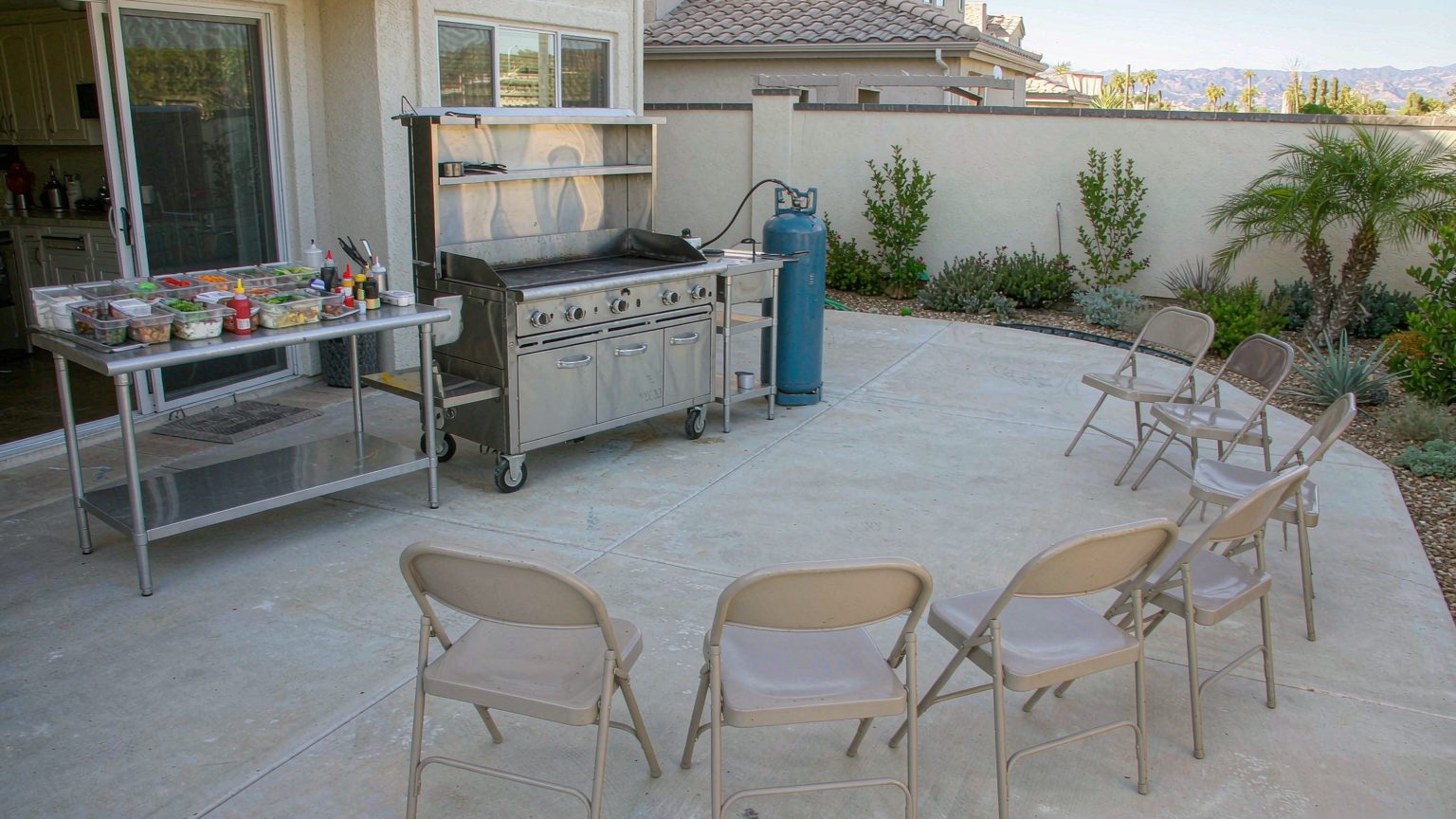
How much space does a hibachi chef need? It is the first question every host asks, usually while standing in their yard trying to picture a grill where the lawn is. The honest answer is that a backyard hibachi setup needs far less room than people expect — but it needs the right room, in the right shape. A generous patio in the wrong configuration can fail while a modest driveway works perfectly. Here is the real footprint, measured in three separate zones, plus the workarounds that make small Orange County yards work beautifully.
The Three Zones of a Mobile Hibachi Setup
Think of a backyard hibachi party as three adjacent areas rather than one big open space. Each has its own minimum, and they do not need to be large — they need to be clear.
Zone 1: The Cooking Station (about 10 × 10 feet)
This is the core requirement: roughly a 10-by-10-foot patch of flat, level, hard or firm ground for the grill and the chef’s working area. The grill itself is not enormous — a mobile teppanyaki unit is comparable to a large outdoor griddle with a cart — but the chef needs room to move around it safely while carrying hot spatulas, oil and food.
What the cooking zone actually needs:
- Flat and level. This is non-negotiable. A sloped surface makes a griddle unsafe to work on, and it is the most common reason a setup gets relocated on arrival.
- Firm footing. Concrete, pavers, decomposed granite and short, dry lawn all work. Loose gravel, deep sand, freshly watered mud and steep artificial turf do not.
- Overhead clearance. No low branches, awnings, patio covers, umbrellas or string-light strands directly above the grill. The show involves real flame and a vented hood, and heat rises.
- Wind protection. A corner of the yard that blocks afternoon gusts beats an exposed ridge. In coastal cities a marine-layer breeze can turn a griddle into a heat sink.
Zone 2: Seating with a View (the show is the point)
Guests do not need to be far from the grill — they should be close. The entire appeal of at-home hibachi is a front-row seat to the cooking, so seating is arranged around the cooking zone rather than across the yard from it.
Practical layout math: an 8-foot banquet table seats 8–10 adults comfortably. Long rectangular tables set in an L or U shape facing the grill give every guest a sightline without anyone craning. Leave a few feet of walking room between the nearest seat and the grill so the chef can pass plates and guests can get up without crossing the cooking zone.
If your yard is tight, a U-shape beats a straight line every time — it wraps guests around the action instead of stacking them behind each other.
Zone 3: The Access Path (the overlooked one)
Your chef arrives with a grill, a propane tank and bins of fresh ingredients. That equipment has to travel from the vehicle to the cooking zone. A clear, reasonably wide, unobstructed path — driveway to gate to patio — saves setup time and avoids a scramble.
- Open the gate before the chef arrives.
- Move cars so the driveway approach is clear.
- Secure pets indoors; they are the most common interference with a smooth setup.
- If there are steps, tell the chef in advance. A single step is nothing; a narrow staircase to a raised deck is worth flagging so the right hand-truck comes along.
The Small-Yard Workarounds That Actually Work
Most Orange County homes do not have a sprawling estate lawn, and they do not need one. The best hibachi setups are often in modest yards:
- The driveway. Flat, level, firm and directly connected to vehicle access. It is the single easiest fix for a small or sloped yard — and in many subdivisions it is genuinely the best cooking surface on the property.
- A side yard or carport. Often flat and sheltered from wind, which is a real advantage.
- The open garage. Not glamorous, but it is the classic weather-insurance location. With clear floor space and the door open for ventilation, a garage setup keeps the party going through a marine-layer drizzle.
- A shared courtyard. Fine for an HOA or apartment setting — just confirm in advance that outdoor cooking is permitted there.
- A neighborhood park or clubhouse patio. Increasingly popular for larger groups. If you go this route, the host handles the reservation and the chef handles the grill.
What the Chef Brings vs. What You Provide
Clearing space is easier when you know who supplies what:
| Item | Provided By |
|---|---|
| Grill, propane, vent hood, tools | Chef |
| All ingredients, sauces, seasoning | Chef |
| On-site cooking and cleanup | Chef |
| Tables and chairs (Classic package) | Host |
| Plates, utensils, napkins, drinkware (Classic) | Host |
| Table and chair setup service | Premium and Luxury packages |
On the Classic package, plan to rent or borrow banquet tables and seating. On Premium, setup of tables and chairs is included, and Luxury is fully all-inclusive. Full package details are on the menu and pricing page.
Do You Need Power or Water?
Generally, no. A mobile hibachi grill runs on its own propane supply, and the chef brings everything needed for the cook. Some setups use a small light for evening events, so it is worth knowing where your nearest outdoor outlet is — but a dark backyard is not a disqualifier. String lights and a phone flashlight are usually enough, and part of the magic of an evening grill is the flame itself as lighting.
Water access helps the chef wash up, and a nearby outdoor spigot or hose is a nice convenience. If you have one, point it out. If you do not, it is not a problem.
Quick Space Checklist Before You Book
- ☐ A 10 × 10-foot flat, level, firm patch identified
- ☐ Nothing overhead: branches, awnings, umbrellas, string lights cleared
- ☐ Wind direction considered; a sheltered corner or wall preferred
- ☐ Seating arranged in an L or U facing the grill
- ☐ Clear walking room between seats and cooking zone
- ☐ Path from vehicle to cooking zone unobstructed; gate open
- ☐ Pets indoors; cars moved
- ☐ Steps or stairs flagged to the chef in advance
- ☐ Weather backup location chosen (garage, carport, covered patio)
Measure with a tape, not your eyes. A surprising number of “too small” yards turn out to have a perfectly workable 10-by-10 corner once furniture and a forgotten trampoline are moved. If you are unsure whether your space qualifies, send a photo when you book your hibachi chef — the chef can usually confirm the layout from a single picture and suggest the best placement on the spot.
The Bottom Line
You do not need a large yard for hibachi at home. You need a flat, level, flame-safe cooking zone of roughly 10 by 10 feet, seating arranged to face the action, and a clear path for the chef to haul in the equipment. Everything else — the driveway fallback, the garage rain plan, the U-shaped table layout — is a detail you can solve in ten minutes with a tape measure and a walk around the property. Hosts in compact Orange County yards host flawless parties every weekend. Yours can be next.
Ready to book your hibachi party?
Private chefs, live teppanyaki and full catering across Orange County. From $60 per person.